
Construction Workflow Management: Complete Guide
Construction workflow management connects permits, change orders, subcontractor vetting, field reporting, and closeout into one clearer AI-supported operating system for smaller contractors.
9 min read
This article is live. It is built to educate first, then move readers toward the audit checklist, the services page, and the next article in the sequence.
Why this article matters
Industry-specific traffic and email capture.
Author
AI Business Services Operations Team
Written by the AI Business Services Operations Team, focused on workflow automation, field reporting, compliance tracking, and admin cleanup for small businesses.
View author profile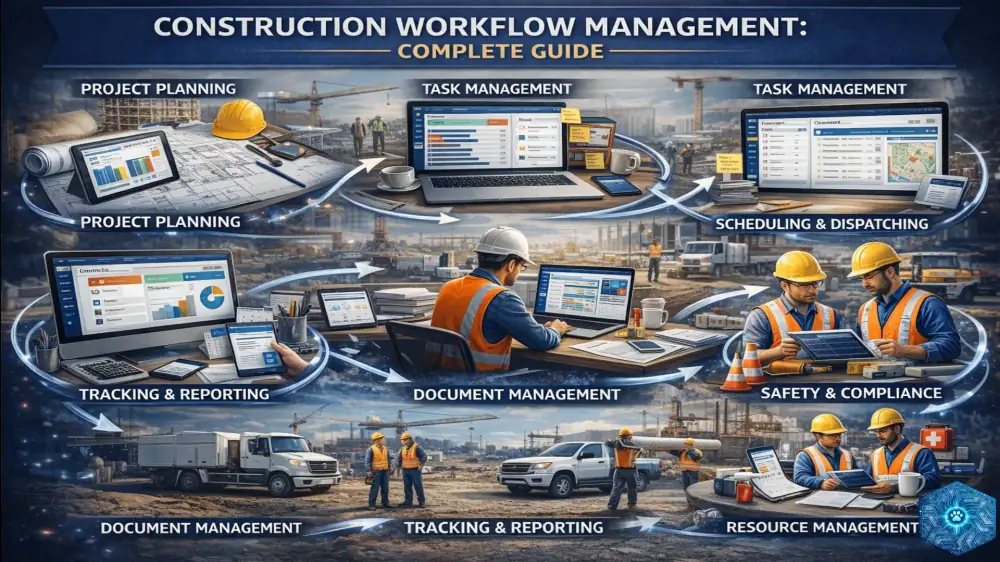
Introduction
In the construction industry, projects succeed or fail based on schedules, budgets, and the countless details that must align perfectly. When the construction workflow breaks down, teams suffer, deadlines slip, and communication falls apart.
This guide walks through the core workflows construction companies need to control, the common points where projects lose time, and how modern construction operations systems with AI-assisted alerts, document handling, and reporting can give smaller contractors better visibility without enterprise-level complexity.
Continue from here
Keep reading if you are still comparing options. Jump into the system if you already see the fit.
Key highlights
- Effective construction workflow management is essential for connecting every part of the project, from planning to closeout.
- Streamlining permit handling, change orders, and subcontractor vetting prevents costly delays and improves project outcomes.
- Construction management software centralizes data, automates repeated tasks, and improves communication between field and office teams.
- Modern workflow tools use AI and automation to predict risks, optimize schedules, and reduce manual work.
- Choosing the right software means evaluating fit, integrations, and user experience, not just feature count.
- Standardized processes and dedicated subcontractor tracking are practical first steps toward better workflow management.
What Is Construction Workflow Management?
Construction workflow management is the digital hub that keeps every part of a project connected. It is a system designed to organize the people, tasks, documents, and approvals that move a job from planning through closeout.
For modern contractors, workflow management goes beyond a task list. It defines who does what, when they do it, and how project data moves between the office, the field, subcontractors, and the client. Instead of relying on scattered emails, paper packets, and manual follow-up, the workflow becomes structured and repeatable.
Defining Construction Workflow Management for Modern Projects
A healthy workflow connects schedules, budgets, field updates, and project documents in one operating flow. Team members can see the right information at the right time instead of waiting for someone to forward a file or make a phone call.
That matters because construction is not just about managing tasks. It is about controlling the handoffs between planning, compliance, field execution, documentation, and payment. When those handoffs are weak, the project slows down even if the work itself is good.
Why Workflow Management Matters in Construction Success
Effective workflow management improves efficiency, reduces waste, and supports better project outcomes. It gives project managers a clearer view of progress and helps teams make decisions based on current information instead of assumptions.
For smaller contractors, this is especially important. They usually do not have the staff or margins to absorb repeated mistakes, delayed approvals, or paperwork-heavy coordination. A cleaner workflow protects both the schedule and the bottom line.
Key Workflows Every Construction Company Should Streamline
Not every workflow has the same impact on profit and delivery. In construction, a few specific processes create outsized risk when they are handled loosely or split across too many tools.
Permit handling, change orders, and subcontractor control are some of the clearest places to tighten the workflow first. These are the paths where disorganization quickly turns into delays, rework, and payment disputes.
Permit Handling and Regulatory Compliance Workflows
Permit delays can stop work entirely. That makes permit handling and regulatory compliance one of the first workflows worth standardizing. The goal is to create a repeatable process for collecting the right documents, submitting them on time, and tracking status clearly.
A stronger compliance workflow lowers the risk of missing documentation, late responses, and surprise issues that surface only after crews are already affected.
- Use checklists so every permit package starts with the same required records.
- Set reminders for submission deadlines and follow-up dates.
- Centralize compliance documents so project teams do not chase files across inboxes and folders.
Change Order Management Process
Change orders are unavoidable in construction, but confusion around them is not. A weak change order process creates scope disputes, delayed approvals, and arguments about cost after the work has already moved forward.
A strong workflow makes every change visible, documented, reviewed, and approved in one clear path. That protects the budget and schedule while giving owners and project managers a cleaner record of how the job evolved.
Subcontractor Vetting and Tracking with Construction Subcontractor Tracking Software
Subcontractors are central to project delivery, which means vetting and tracking them should be treated as a control system, not a basic contact list. The workflow should verify licenses, insurance, tax records, and current approval status before field work or payout review moves forward.
This is also where smaller contractors can gain a major advantage. Standardizing subcontractor control helps prevent avoidable risk without needing a bloated enterprise platform.
- Track insurance, licenses, and related compliance records in one place.
- Monitor document expiration dates before they become payout or schedule problems.
- Centralize communication and status updates so all stakeholders are looking at the same record.
Common Workflow Management Challenges in Construction
Construction teams often feel the symptoms of workflow breakdown before they can clearly see the cause. Delays, miscommunication, missing documents, and duplicated admin all show up as daily friction long before someone maps the actual problem.
The most common construction workflow problems usually come from disconnected records, manual processes, and weak communication between the office and the field.
Miscommunication and Documentation Gaps
When project managers, office staff, and field crews are not working from the same record, important details get lost. Verbal instructions, fragmented email threads, and outdated documents create mistakes that ripple across the project.
A centralized workflow reduces this risk by giving everyone access to the same information and a clearer way to communicate updates, approvals, and issues.
- Use one source of truth for plans, documents, and change records.
- Reduce confusion by standardizing where updates are posted and reviewed.
- Make project status visible to both the office and the field.
Delays Caused by Manual Processes
Manual logs, spreadsheet handoffs, printed forms, and physical signatures all slow down project delivery. These habits create bottlenecks because the next decision often depends on paperwork being moved, reviewed, or re-entered.
As project volume grows, those manual steps become harder to manage. Time gets lost in administrative cleanup instead of field execution and decision-making.
Addressing Inefficiencies with Construction Operations Systems
Construction operations systems are designed to centralize scheduling, documentation, compliance, and reporting into one clearer operating layer. Instead of asking teams to manage a project across multiple disconnected tools, they give owners and managers better visibility inside one workflow.
For small and mid-sized contractors, the best fit is often a system that is lighter than enterprise software but still strong enough to control reporting, subcontractor approvals, and project handoffs.
How Construction Workflow Management Software Transforms Operations
The value of construction workflow software is not just that it digitizes paper. The real value is that it connects planning, field execution, and back-office control into one working system.
That means less time spent tracking down updates and more time spent managing the project with current information.
Features to Look For in Construction Workflow Management Tools
The right software should help teams coordinate work in real time, manage documents cleanly, and give project managers a more accurate picture of progress.
- Real-time collaboration between field and office teams.
- Document management and version control.
- Resource scheduling and task tracking.
- Reporting and analytics for progress and risk visibility.
- Integration with accounting, ERP, and other core systems.
- A user experience that smaller teams can adopt quickly.
Benefits for Small and Mid-Sized Contractors
Smaller contractors need efficiency more than complexity. Construction workflow software can improve cost management, reduce wasted admin time, and help teams scale without rebuilding their systems every time the company grows.
This is where custom operations systems can be especially useful. Instead of forcing a small contractor into a huge enterprise rollout, the workflow can be shaped around the company actual field and office process, then strengthened with AI that flags delays, summarizes field updates, and highlights risk before the owner has to spot it manually.
- Improved cost control through better visibility.
- Higher productivity by automating repeated admin tasks.
- Better scalability as more projects and crews are added.
Integration Capabilities Across Construction Operations Systems
Construction software should not become another isolated record. It should connect to accounting, payroll, CRM, and related systems so data can move cleanly without manual re-entry.
When integrations are handled well, owners get a single source of truth and project teams spend less time reconciling disconnected records.
AI, Automation, and Technology Trends Shaping Construction Workflow Management
Construction technology is moving beyond simple digitization. AI and automation are now being used to identify risk earlier, reduce manual review work, and improve communication between the office and the field.
For contractors, the opportunity is not chasing hype. It is using these tools to strengthen the workflows that already matter most.
AI Solutions for Optimizing Construction Workflows
AI can analyze project data to identify patterns, forecast schedule risks, and surface issues before they become expensive. That supports more proactive construction management instead of reactive cleanup.
- Automated document analysis for contracts and specifications.
- Risk identification based on quality, schedule, and safety patterns.
- Faster answers through natural language access to project data.
Automation Tools for Workflow Tracking and Alerts
Automation handles repeated steps like reminders, routing approvals, and surfacing delays. Instead of waiting for someone to notice a problem, the workflow can alert the right person at the right time.
That reduces manual follow-up and helps small teams stay ahead of project friction.
Mobile Access and Cloud-Based Construction Operations Systems
Field teams need access to the latest plans, schedules, and records from the job site. Cloud-based systems make that possible without forcing information to wait until someone returns to the office.
This improves coordination, reduces document confusion, and helps keep the office connected to real field conditions in real time.
Practical Tips to Improve Construction Workflow Management
Workflow improvement does not need to start with a massive overhaul. Often, the strongest first step is to standardize the repeated work that already causes the most friction.
Templates, checklists, and subcontractor tracking are practical places to start because they reduce variation and make the next automation step easier.
Standardizing Processes with Customized Templates
Templates create consistency for recurring tasks like RFIs, submittals, reports, and approval flows. When the workflow starts from a standard structure, teams spend less time recreating the same process on every project.
- Reduce setup time on new projects.
- Lower the chance that important steps are missed.
- Create a clearer path for training and quality control.
Leveraging Construction Subcontractor Tracking Software for Better Oversight
Construction subcontractor tracking software improves oversight by giving project managers one place to verify compliance, monitor progress, and manage communication.
That level of visibility is especially valuable when multiple subcontractors are moving across different phases of a project and each one affects risk, schedule, and payout review.
Conclusion
Construction workflow management is not just about organization. It is about protecting the schedule, budget, quality, and communication that determine whether a project runs well or turns into constant cleanup.
By streamlining permit handling, change orders, subcontractor vetting, field reporting, and AI-assisted system integrations, contractors can reduce wasted time and create more predictable project delivery.
For small contractors, the best next step is usually not buying the biggest platform. It is tightening the workflows that matter most, then building from there with tools that fit the way the company actually operates.
Download and next step
After you implement this template, see how it works as part of a complete automated system.
Frequently asked questions
How can construction workflow management software help reduce wasted time on projects?
Construction workflow management software reduces wasted time by automating repeated tasks, centralizing communication, and giving teams real-time access to project information. That helps reduce delays caused by manual processes and makes it easier for project teams to focus on execution instead of admin cleanup.
What are the best construction workflow management solutions for small contractors?
The best fit depends on the contractor, but smaller teams usually benefit most from tools that balance structure, speed, and usability. The strongest options are the ones that improve reporting, communication, and oversight without forcing the business into enterprise-level complexity.
Are there industry-specific workflow management tools tailored for project owners?
Yes. Many workflow tools are built specifically for construction and project oversight. The right system gives project owners visibility into financials, schedules, documentation, and field progress so they can make better decisions with current information.
Next-step paths
Related next reads